Follow on Twitter using the following hashtags or usernames: #NFD41
Watch on YouTube
Watch on Vimeo
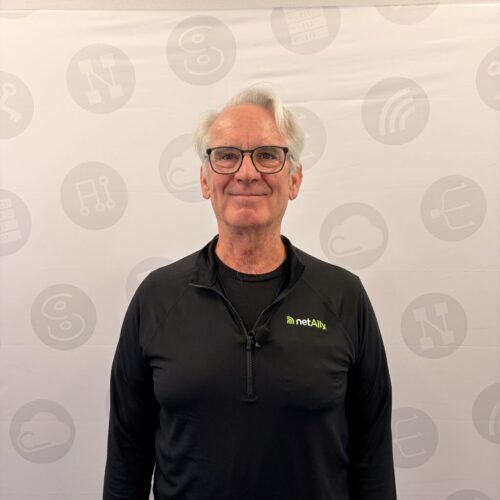
100G has moved out of the data center and into the distribution switch down the hall, but most enterprise teams have nothing that can test it. It also doesn’t behave like a faster 10G: links can look healthy right up until they fail. NetAlly VP of Product Thomas Doumas introduces the LinkRunner 100G, a handheld tester that brings high-speed Ethernet testing to enterprise teams. Doumas, who helped create the original LinkRunner at Fluke Networks in 2000, presented the product to delegates at Networking Field Day 41.
Doumas explained that 100G interleaves four 25G lanes. On short-reach multimode fiber those lanes are separate fibers, and on single-mode they are separate wavelengths. Raw links run at a bit error rate near 10^-5, and forward error correction brings that to the roughly 10^-14 Ethernet needs. Both ends must use the same FEC scheme, and nothing auto-negotiates speed, FEC, or lane layout, which leaves about 30 ways a port might link. FEC also hides slow degradation. One London customer paired a long-range optic with a short-range one, and the overdriven receiver eventually overheated and failed weeks later. The LinkRunner 100G works with the customer’s own transceivers. Its QSFP28 Insights app reads module memory, tries every possible link mode, catches double-FEC configurations, and exposes breakout ports. Auto-test then works up the stack to flag rogue DHCP servers and trace switch paths, and a pair of units runs bidirectional Y.1564 performance tests at up to 100G.
Doumas framed the tool as a replacement for workarounds that fall short. Servers can’t push 100G for iperf. Laptop-and-media-converter setups rely on guesswork. Optical testers from EXFO or VIAVI cost $25,000 to $75,000 and characterize glass rather than networks. Teams also stop “swapping their way to success” and filling boneyards with $3,000 transceivers that may be perfectly fine. Through the LinkLive cloud service, an on-site technician can plug the unit in while a remote engineer runs it. Doumas acknowledged gaps when delegates asked: this model has no packet capture and no RoCEv2 visibility, and he said NetAlly wants to learn more about those needs. His strongest case was financial. A Seattle beta customer replaced a $30,000-per-month 100G wavelength service with $3,000-per-month dark fiber that it turned up itself, saving $27,000 every month.
Personnel: Thomas Doumas
Watch on YouTube
Watch on Vimeo
Networks are getting harder and experienced engineers are scarce. Thomas Doumas looks at where network engineering is headed in the AI era and why the physical layer still matters. He then introduces Ally Intelligence, NetAlly’s guided troubleshooting on the handheld tester. It helps frontline techs fix problems before they escalate and helps senior engineers work faster. Doumas presented this look ahead at Networking Field Day 41 and took delegate questions throughout.
Doumas argued that the work never ends. He described large customers whose teams do nothing but replace switches as they reach the end of three-to-five-year lifecycles. He expects AI coding tools to create network problems rather than solve them, because cheaper software development will flood networks with new apps and traffic. No prompt, he noted, can produce a physical tester. Ally Intelligence is NetAlly’s response to the “wall of data” that most tools present. It takes the tester’s measurements and runs them through built-in flowcharts that point to likely root causes, walk technicians through fixes, and validate the results. Doumas said it is not a language model. It is an expert system written by NetAlly’s engineers, and it runs offline on the unit. It launched last quarter with PoE checks and rogue DHCP detection, which can show where a rogue server is plugged in. Wi-Fi troubleshooting arrives this quarter. Planned DNS tests will query both configured servers and compare their forward and reverse answers. The tester has no API of its own, but results upload to LinkLive as soon as each test finishes, or queue until a connection returns, and can be queried there.
Doumas said network engineers face only two problems: “I can’t connect” and “it’s slow.” NetAlly will keep filling in the root causes behind each one and will deliver them as software updates. It will also extend the approach to its AirCheck and EtherScope Wi-Fi tools, where he said troubleshooting is at least as complicated. Future versions may grade results against known-good baselines or configurations loaded through LinkLive, though he wants to conclude as much as possible without asking users to do extra work. On speeds beyond 100G, Doumas said NetAlly enters a market once a technology is established in customer networks, and he expects 400G to follow eventually. Delegates pressed for AI fabric testing that covers PFC, ECN, Ultra Ethernet packet spraying, and fiber connector mismatches. They argued that because idle GPUs cost organizations thousands of dollars every second, even an expensive tester would pay for itself.
Personnel: Thomas Doumas
Thank you for being part of the Tech Field Day community! Our mailing list is a great way to stay up to date on our events and technical content, and we appreciate your signup.
We promise that we’ll never spam you, send ads, or sell your information. This list will only be used to communicate with our community about our events and content. And we’ll limit it to no more than one message per week.
Although we only need your email address, it would be nice if you provided a little more information to help us get to know you better!