Follow on Twitter using the following hashtags or usernames: #NFD41
Watch on YouTube
Watch on Vimeo
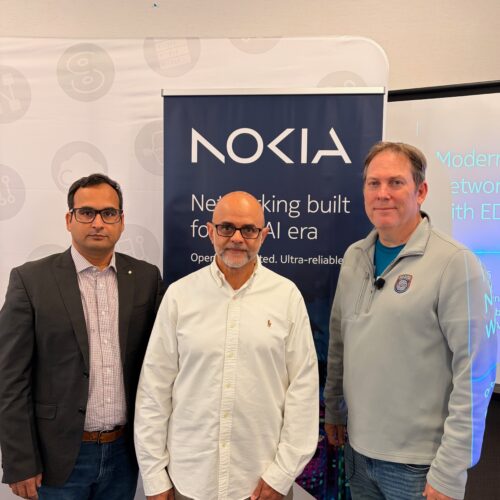
Mike Bushong and Pushpendra Pandey of Nokia open the company’s presentation by examining the widening gap between AI-driven industry hype and the day-to-day realities of enterprise network operations. Using Nokia’s own IT organization as a real-world case study, they explain why the company consolidated a complex, multi-vendor data center estate onto SR Linux and EDA, and what the migration delivered. The session opened Nokia’s appearance at Networking Field Day 41.
Bushong framed the session with a lesson from an SDN startup whose technically superior product failed because it could not survive contact with customers. He noted that capital spending by the top five hyperscalers grew from roughly $250 billion in 2024 to about $750 billion two years later, yet that activity is irrelevant to about 80 percent of the market, where only 20 to 30 percent of operations are automated. Pandey described the technical debt Nokia’s IT team had inherited through mergers: 21 data centers and roughly 14,000 ports built on HP, Cisco Nexus, and OmniSwitch platforms. Two days into his leadership role, a bent cable caused both firewalls in Nokia’s dual Finland data centers to go active-active, producing a five-hour outage, while spanning tree events routinely turned two-second network flaps into two-hour outages for fragile MES applications.
Pandey set a simple requirement for a network that was easy to deploy, migrate, and operate, and after an open vendor evaluation the team chose SR Linux with EDA. Over close to a year, it deployed, migrated applications to, and began operating all six large data centers. Since the start of the year, Nokia has had one data center outage, a failing SFP identified through EDA statistics and resolved in 40 minutes, compared with two to three outages a month previously. Pandey credited the shift to intent-based operations validated in a digital twin, arguing that an engineer’s expertise lies in arriving at the right configuration, not keying it into a hundred devices. Asked whether simplification merely relocates complexity, he traced much of it to configuration drift as engineers come and go, insisting that application owners should consume the network like a utility.
Personnel: Mike Bushong, Pushpendra Pandey
Watch on YouTube
Watch on Vimeo
Ahmed Abutaleb, data center architect at Nokia, explains how the problems of an inherited multi-vendor environment shaped the architecture of Nokia IT’s new data centers. He walks through templated building blocks, intent expressed as code in Git, a Kubernetes-native controller, an on-demand digital twin, and continuous drift detection, along with brownfield migration lessons and the agent-driven operating model the team is targeting. The session was part of Nokia’s appearance at Networking Field Day 41.
Abutaleb described a starting point of Cisco, HP, and OmniSwitch fabrics, some past end of service since 2010 and running so hot that engineers were afraid to touch them, alongside a mix of layer 2, layer 3, and EVPN designs and rigid tools. An early audit found a network that was working but wrong, with design documents that no longer matched reality. The new design divides each data center into tested templates for fabrics, server connectivity, firewalls and load balancers, and subnets, with applications choosing from three connectivity models. Engineers express intent in YAML, often through Cursor in natural language, while details such as BGP, EVPN, and BFD stay hidden. Nokia’s internal GitLab serves as the source of truth, and a Kubernetes-native controller treats network objects the same way it treats software services.
Changes go first to a digital twin in GCP that wakes up, mirrors a production fabric, runs automated traffic tests, and generates a method of procedure with test evidence before going back to sleep, though Abutaleb acknowledged the twin covers only the data center, not the WAN, firewalls, or load balancers. The team dropped Argo CD after GCP throttling stretched syncs to 30 or 40 minutes, and built continuous drift detection that flags any unreconciled change, a design he said the product team later built into EDA. Greenfield fabrics come up through zero-touch provisioning in minutes, but brownfield migrations required learning application traffic flows, storage access, and link ordering, since factories tolerate only a few seconds of disruption. Early migrations caused outages, but once application, infrastructure, and network teams cooperated, the final migration went cleanly, setting up the team’s target of a single agent window spanning ServiceNow tickets, fabrics, and alarms.
Personnel: Ahmed Abutaleb
Watch on YouTube
Watch on Vimeo
Aakash Kumar and Ahmed Abutaleb of Nokia demonstrate the everyday change workflow Nokia IT uses for its data center fabrics. Working through Cursor in natural language, they show documentation generated from code, a GitLab branch tied to a change number, an on-demand digital twin in EDA, automated traffic testing, and an auto-generated merge request, before tearing the twin back down. The session, part of Nokia’s appearance at Networking Field Day 41, paired a recorded demo from Kumar with live narration from Abutaleb.
In a lab with two interconnected leaf, spine, and superspine data centers, Kumar showed that every element of the fabric lives as code in GitLab, with one repository per fabric and a single topology YAML file that doubles as live documentation. Cursor reads that definition to draw diagrams on demand and flag gaps, guided by a rules file Abutaleb built by correcting the agent over time, plus EDA and SR Linux guides. To add a server, the engineer creates a branch tied to a change number, and the agent drives GitLab pipelines that populate an empty digital twin as an exact copy of the lab. Cursor produces a plan for review, edits the YAML on approval, interprets the EDA dry-run transaction, and runs east-west and north-south tests, documenting one expected failure in a merge request before the twin is torn down within minutes.
Addressing concerns that the workflow is developer-centric, Abutaleb noted that only Kumar has a software background, and Andy Lapteff said the natural language interface had dissolved his own objections. Abutaleb added that the pipelines the team built are now in the product, that tests are standard one-line commands the team defines, and that routine additions use a production dry run rather than the twin, which is reserved for topology changes or unfamiliar devices. Firmware upgrades remain a separate operation. Next steps include read-only access so Cursor can pull live state, integration with IPAM, NetBox, and ServiceNow so VLANs and subnets are allocated automatically from service requests, and upgrading switch software by gradually draining traffic so services stay up, part of the team’s goal of running its data centers with the ease of a private cloud.
Personnel: Aakash Kumar, Ahmed Abutaleb
Thank you for being part of the Tech Field Day community! Our mailing list is a great way to stay up to date on our events and technical content, and we appreciate your signup.
We promise that we’ll never spam you, send ads, or sell your information. This list will only be used to communicate with our community about our events and content. And we’ll limit it to no more than one message per week.
Although we only need your email address, it would be nice if you provided a little more information to help us get to know you better!