

At Qlik Connect 2025, Stephen Foskett led a series of insightful interviews, each highlighting key innovations in data analytics, AI integration, and enterprise-level solutions. Through conversations with Qlik experts and partners, these interviews explored the current state of AI, data integration, and analytics, while providing an in-depth look at Qlik’s evolving platform. The event underscored the growing importance of responsible AI, scalable data solutions, and open standards in shaping the future of enterprise analytics.
In the first interview, Foskett spoke with Mary Kern, VP of Analytics Go-To-Market at Qlik, and Rumman Chowdhury, CEO of Humane Intelligence and a member of Qlik’s AI Council, about the role of responsible AI in analytics. They discussed the challenges of AI implementation in business, emphasizing the importance of trust, inclusivity, and bias mitigation. Chowdhury highlighted the democratizing force of open-source AI, stressing the necessity of inclusive engagement and global participation in AI development. Kern added that the future of analytics lies in AI’s ability to enhance human performance rather than replace it, with a focus on accessibility and intuitive interaction with data through language models.
Next, Foskett interviewed Sam Pierson, SVP of R&D at Qlik, and Ori Rafael, Senior Director of Engineering at Qlik, regarding the launch of Qlik’s Open Lakehouse. This platform bridges the gap between unstructured data lakes and highly governed data warehouses, enabling organizations to manage their data more efficiently. The Open Lakehouse leverages open standards like Apache Iceberg, offering scalability, performance, and cost-efficiency. Rafael discussed how Upsolver’s technology, now integrated into Qlik, simplifies the ingestion and management of large datasets, making data more accessible and usable without the overhead typical of traditional systems.
Foskett then talked with Michael Bronstein, a DeepMind Professor of AI, and Nick Magnuson, Head of AI at Qlik, to explore the transformative potential of agentic AI. The conversation centered on AI’s evolving role in scientific and enterprise fields, particularly its ability to assist in hypothesis generation and decision-making. Bronstein highlighted agentic AI’s potential to revolutionize scientific discovery, while Magnuson emphasized the need for scalable data infrastructure to support AI’s increasing demands. They discussed how Qlik is facilitating this shift by creating tools that enable AI to engage more deeply with data and contribute to the scientific method.
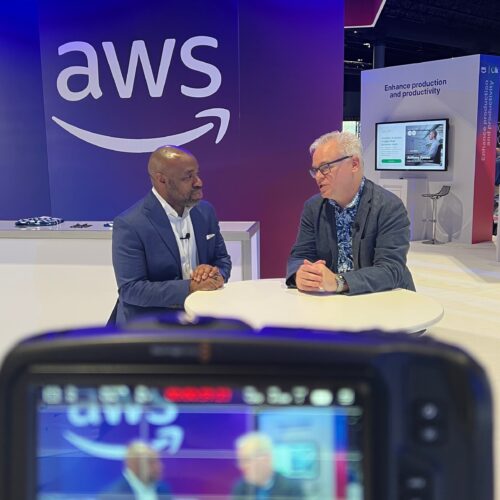
Olawale Oladehin from AWS sat down with Foskett to discuss the AWS-Qlik collaboration and the progress made in advancing enterprise AI adoption. Oladehin explained how the partnership benefits customers by combining Qlik’s data integration capabilities with AWS’s robust infrastructure. The discussion covered the use of open standards like Apache Iceberg, which promote interoperability and reduce vendor lock-in. They also addressed the importance of responsible AI, with Oladehin highlighting the role of tools like Amazon Bedrock in ensuring ethical AI usage across industries like finance and healthcare.
Lastly, Foskett interviewed Mike Potter, CTO at Qlik, about the company’s advancements in AI-driven analytics. Potter explained how Qlik’s platform now manages the entire data lifecycle—from ingestion to actionable insights—through the integration of AI. The interview focused on Qlik’s tools, such as Qlik Answers, which democratize access to data by enabling natural language queries. Potter also discussed how Qlik is addressing the challenges of cloud migration, emphasizing the importance of flexibility, strategic partnerships, and open standards in ensuring seamless integration across diverse systems.