Watch on YouTube
Watch on Vimeo
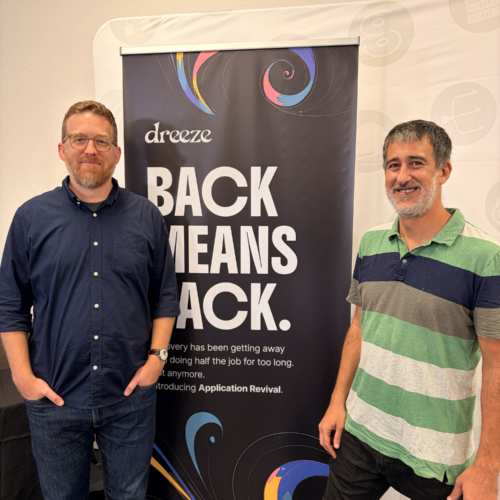
Kevin Cole, Head of Product Marketing at Dreeze, introduced the company as a new cloud backup and recovery startup. Dreeze launched after spending over a year gathering feedback from large enterprises and partners on their ongoing challenges. The co-founders, Ziv, Oded, and Avi, bring over two decades of industry experience, having previously co-founded Kasha (now RecoverPoint) and Zerto (now HPE Zerto Software), products widely used by Fortune 100 companies. Dreeze aims to provide a new cloud backup and recovery platform as enterprises adopt cloud technologies, addressing a perceived need for a different approach.
Cole acknowledged the crowded backup space but asserted that persistent and recurring gaps exist in how data protection is currently handled in the cloud. These gaps were identified through extensive discussions with Fortune 100 and Fortune 500 companies. The presentation frames these changes around three key areas: how cyber has increased the urgency for resilience due to prevalent cloud attacks, how AI has changed the nature of adversaries and the continuous threat landscape (making “assume breach” more critical and redefining insider threats), and how the cloud has fundamentally changed what an application looks like, moving from a few VMs on-premises to hundreds or thousands of resources across numerous services, leading to increased complexity and configuration errors.
Enterprises are now rethinking resilience, expecting to be attacked, and viewing cyber recovery as an inevitability rather than just an insurance policy. They are re-architecting for an “agentic world” and wrestling with cloud complexity by orienting around applications, which is what the business truly values, rather than individual components like EC2 or EBS. Dreeze’s platform is built to solve these challenges, focusing on the ability to get entire applications back up and running, securely and in an automated fashion, to restore business as usual.
Personnel: Kevin Cole
Watch on YouTube
Watch on Vimeo
Avi Raichel from Dreeze introduced the presentation by highlighting a critical issue discovered through interviews with over 100 enterprises: while most companies can recover their data in the cloud, the application itself often remains non-functional, hindering business resumption. He noted that data restoration is considered “table stakes,” but the actual application recovery process is complex, manual, reliant on specific human knowledge, not repeatable, and can take days. This lack of confident, swift application recovery capability creates a significant challenge for CIOs in assuring resilience to their boards.
Avi then detailed why cloud-native applications present this challenge, illustrating their intricate architecture involving hundreds of interconnected resources across network, identity, data, and application layers, along with external service dependencies. This complexity creates four key gaps in application recovery. First, a “knowledge gap” exists because it’s hard to know the application’s true composition, with constantly changing dependencies, scattered documentation, and no single live application map. Secondly, there’s a “protection gap” where only data is typically backed up, leaving the crucial infrastructure, application configurations, and third-party connectivity unprotected.
This creates an “orchestration gap” during recovery, as rebuilding an application becomes a manual, improvised effort dependent on specific individuals, often involving outdated runbooks and trial and error during critical incidents. The lack of an automated sequence means recovery takes days, not hours. Finally, a “validation gap” arises because the manual and difficult nature of recovery makes testing infrequent, turning each test into a significant project. This infrequency means companies lack current, reliable SLAs for recovery, essentially operating on “hope” rather than proven resilience. Collectively, these four gaps prevent customers from effectively recovering their cloud-native applications.
Personnel: Avi Raichel
Thank you for being part of the Tech Field Day community! Our mailing list is a great way to stay up to date on our events and technical content, and we appreciate your signup.
We promise that we’ll never spam you, send ads, or sell your information. This list will only be used to communicate with our community about our events and content. And we’ll limit it to no more than one message per week.
Although we only need your email address, it would be nice if you provided a little more information to help us get to know you better!