
|
|
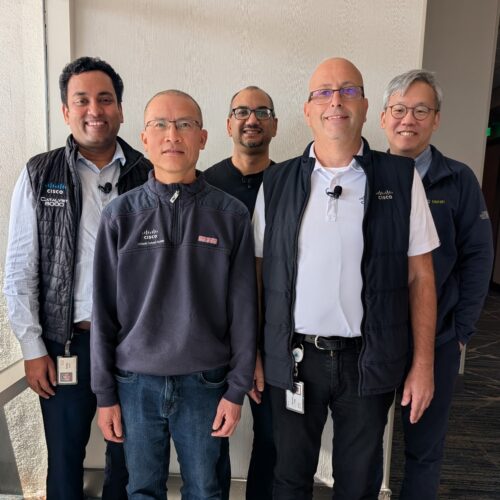
![]() Rahul Sagi, Kenny Lei, Kiran Ghodgoankar, Shai Silberman, and Minse Kim presented for Cisco Enterprise Networking at AI Infrastructure Field Day 4 |
This Presentation date is January 28, 2026 at 10:30AM - 12:30PM PT.
Presenters: Kenny Lei, Kiran Ghodgaonkar, Minse Kim, Rahul Sagi, Shai Silberman
It’s Time for a New Kind of Network.
One that’s not retrofitted for AI—but purpose-built for it. Designed to handle the scale, speed, complexity, and security demands of the AI era—from the ground up. Cisco’s next generation of switching, routing, and wireless devices are purpose-built to support any customer’s AI transformation. Built for campus, branch, and industrial floor, only Cisco infrastructure can meet the scalability, flexibility, and performance needed to optimize today’s application experiences and scale for future AI demands.

Cisco Enterprise Networking Vision, Strategy, and Execution
Watch on YouTube
Watch on Vimeo
Cisco presents its enterprise networking vision and strategy, detailing how it is executed from a platform perspective, particularly in the context of the rapidly evolving AI era. Kiran Ghodgaonkar, who leads product marketing for Cisco’s Secure WAN portfolio, introduced the session and outlined how the company is adapting its familiar routing, switching, wireless, and management products. With over 40 years of history, Cisco has been at the forefront of innovation through previous disruptions, including the internet, mobile, and cloud eras, consistently focusing on connecting people to users and applications. The current AI era, however, necessitates a fundamental rethink of how networking products are built to adapt to evolving application and data consumption.
In this new landscape, Cisco observes three consistent themes among its customers: increasing complexity from diverse devices and disparate product stacks; significant IT hiring and budget constraints exacerbated by a skills gap in networking and security; and the challenge of deploying long-lived networking equipment in a fast-evolving AI environment. To address these concerns and build an AI-ready, secure network, Cisco’s strategy is founded on three key pillars. First, it focuses on simplifying operations through Agentic Ops to assist IT leaders. Second, the strategy emphasizes integrating security directly into the network, leveraging it as a primary line of defence against emerging threats such as deepfakes and data leakage, while also adhering to new standards such as NIST post-quantum cryptography. Finally, Cisco aims to develop scalable AI-optimized devices that can simultaneously handle networking and security functions with low latency for demanding AI workloads.
Building hardware for the AI era means a significant evolution in Cisco’s approach. This includes developing custom silicon to deliver high bandwidth, performance, post-quantum readiness, and integrated security, moving beyond the limitations of off-the-shelf solutions. Enhanced observability, including deep packet inspection, is also crucial. For its operating system, IOS XE, Cisco is focused on easier deployment and upgrades without downtime, deep observability, efficient container execution, and robust programmability to support secure API communication for telemetry and management tools. From a broader systems perspective, the company is prioritizing visibility, programmability, and the maintenance of an open, interoperable ecosystem. A critical consideration for these systems is power efficiency, acknowledging networking equipment’s energy consumption and the growing importance of sustainability and carbon footprint management globally.
Personnel: Kiran Ghodgaonkar
Cisco Enterprise Networking Platform Approach
Watch on YouTube
Watch on Vimeo
Cisco is unifying its enterprise networking platforms (Meraki and Catalyst) to deliver a single, consistent user experience with common AI and data services, consistent APIs, and shared workflows across cloud, on-prem, and hybrid deployments. This unification began with the creation of a dedicated network platform team that brought together the Meraki and Catalyst groups to foster a “build once, deploy twice” philosophy. New Cisco hardware, including switches, wireless routers, and IoT equipment, now supports both cloud and on-premises management out of the box, allowing customers to choose their preferred management method without making purchasing decisions based on deployment. This approach ensures consistent outcomes and experiences by leveraging the same underlying engines and logic across all platforms.
The convergence journey also includes a unified hardware and licensing model, a “magnetic UI framework” for a common user experience across all Cisco products, and consistent APIs. These APIs enable common tasks, infrastructure as code, and robust integrations with third-party systems such as ServiceNow and Splunk, as exemplified by the API-driven setup of the Paris Olympics infrastructure. At the core is a common AI and data layer, powered by a single Cisco cloud and shared algorithms. This enables deployment of the AI Assistant chatbot on both the Meraki Dashboard (generally available) and the Catalyst Center (open beta), using the same backend to deliver identical experiences and use cases. Additionally, Cisco Workflows, a free low-code solution, is integrated into the Meraki interface, offering templates and horizontal integration across domains and even other vendor products via APIs.
Further advancing management capabilities, Cisco introduced “Global Overview,” a generally available cloud-based product designed for customers operating both cloud and on-premises infrastructures. Global Overview provides a single cloud experience to integrate multiple Meraki organizations and Catalyst Centers, offering consolidated network health visibility, unified inventory, and single sign-on for seamless cross-launching into specific management platforms. Complementing the AI Assistant, AI Canvas (currently in alpha) offers cross-domain collaboration and troubleshooting by integrating multiple data sources and third-party applications via natural language AI agents. Cisco’s AI is powered by a proprietary “deep networking model,” a purpose-built Large Language Model trained on Cisco’s extensive knowledge base, including TAC and CX insights, to deliver highly specific, accurate networking solutions without using customer data and to continuously learn from live telemetry. This innovative approach aims to accelerate root-cause analysis and provide automated remediation while maintaining a human-in-the-loop model to build customer trust.
Personnel: Shai Silberman
Secure Routing for AI with Cisco Enterprise Networking
Watch on YouTube
Watch on Vimeo
Secure Routing with Cisco Enterprise Networking tackles the increasing complexity, user experience demands, and security requirements of modern WAN networks, especially with the advent of AI branches. Rahul Sagi introduced Cisco Secure Routers, launching in 2025, designed to converge Cisco’s best-in-class networking with advanced security in a single product. This convergence is enabled by a new Secure Networking Processor (SNP) that delivers the high throughput and capacity essential for future AI applications. These routers offer comprehensive on-box security capabilities, including a full stack of hybrid mesh firewalls with IPS/IDS, URL filtering, and AMP Threat Grid, while also supporting cloud security options for direct Internet access (DIA) use cases.
The Secure Networking Processor, an ARM-based chip with Cisco IP, is central to these innovations, enabling inline cryptographic acceleration and a natively integrated Next-Generation Firewall (NGFW) stack for superior performance. Cisco highlights significant improvements, including up to three times the IPsec performance and high security efficacy, with threat protection throughput reaching up to 11 Gbps even with all security features enabled. Addressing the impending threat of quantum computing, the new portfolio integrates Post-Quantum Cryptography (PQC) algorithms, specifically ML-CEM for key exchanges in WAN transport (IPsec and MACsec) and quantum-resistant secure boot, ensuring networks are future-proofed against quantum attacks by 2030, a critical concern for sectors like public, healthcare, retail, and finance. The secure routers also boast improved power efficiency and increased WAN interface capacities, supporting up to 100 Gbps, to handle the escalating I/O demands of AI-driven environments. Furthermore, some platforms include a dedicated AI/ML engine for local inferencing to enhance network performance in future software releases, and native zero-trust principles are embedded throughout the system.
Beyond hardware, Cisco is leveraging AI to simplify WAN operations, offering “AI for networking” tools for administrators. This includes “Branch as Code” with Cisco Validated Designs and integration into CI/CD pipelines for automated, scalable deployments across hundreds of sites. The AI Assistant in management solutions such as Catalyst SD-WAN Manager and the Meraki dashboard streamlines configuration and troubleshooting. Specific AI-powered features include Predictive Path Recommendations, which analyze historical network behavior to suggest optimal transport paths for applications at specific times, and Bandwidth Forecasting, which helps predict and plan for circuit upgrades. Anomaly Detection continuously monitors network attributes such as round-trip time, jitter, and loss to proactively alert administrators to anomalous behavior, reducing troubleshooting time. These combined efforts aim to deliver AI-ready networking products, simplify WAN operations with intelligent tools, and reduce risk across all layers with robust, future-proof security controls.
Personnel: Rahul Sagi
Resilient Wireless Networks for AI with Cisco Enterprise Networking
Watch on YouTube
Watch on Vimeo
Minse Kim, Cisco’s wireless product manager, emphasized that the AI era is profoundly changing enterprise networking, extending beyond data centers to encompass “physical AI” applications in factories, medical facilities, and dynamic workspaces. He noted that surging demand for AI infrastructure components is also influencing customer buying cycles, with some customers proactively investing in Wi-Fi 7 now. A key insight is that while AI infrastructure is often perceived as data center-centric, the actual consumption and training of AI models, particularly for robotics and autonomous systems, relies heavily on high-performance, low-latency wireless connectivity, making Wi-Fi 6, 6E, and 7 crucial “last mile” technologies. Cisco’s Wi-Fi 7 access points are designed to meet these demands, offering multi-gigabit speeds and backhaul capabilities up to 20 Gbps per AP.
Addressing Wi-Fi’s traditional reliability-versus-speed trade-off, Cisco has developed Ultra-Reliable Wireless Backhaul (URWB) capabilities integrated into its Wi-Fi 7 APs. By dedicating a radio, URWB provides a stable, predictable, and low-latency “wired-like” connection, which is essential for critical applications like robotics that cannot tolerate the blips and jitters common in traditional Wi-Fi during client roaming. Beyond connectivity, Cisco Wi-Fi 7 APs also enhance spatial awareness and location services. Leveraging technologies such as 802.11mc (FTM) and Ultra-Wideband (UWB) with sensor fusion, these APs deliver sub-meter (e.g., one-foot) location accuracy and low latency, resolving long-standing problems in asset tracking and network operations, as demonstrated by real-time asset tracking in an office environment. This ability to accurately digitize the physical world is fundamental for AI analytics.
Furthermore, Cisco is integrating AI into network operations to simplify management and optimize performance. For instance, AI models leverage telemetry data from 35 million Cisco APs globally to intelligently manage firmware upgrades, learning from customer rollback decisions to improve future deployments. AI also enhances Radio Resource Management (RRM) by moving beyond simple rule-based engines to intelligently optimize RF configurations, leveraging historical interference patterns and dynamically adapting to environmental changes to maximize network efficiency and stability. Cisco is even introducing the concept of APs acting as “synthetic clients” to proactively collect network statistics and provide informed recommendations. This comprehensive AI-powered approach, delivering ultra-reliable, high-speed wireless, precise spatial awareness, and intelligent network automation, is not a future vision but a current reality, with thousands of customers already using Cisco’s AI-powered network solutions.
Personnel: Minse Kim


